

Modern industrial production wouldn’t be what it is today without technologies such as additive manufacturing and CNC machining. Each method has its unique way of creating different parts and components. Both techniques add something of value to the industry and have their place in the production process.
In this post, we’ll go over the difference between additive manufacturing and CNC machining, and show you how to use each one to your benefit.
You’ll learn why that difference plays a significant role in how each technology is used to fabricate complex parts. We’ll tell about the key distinctions between these two manufacturing processes, as well as their unique advantages and applications in the industry and why manufacturers choose to use one technology over the other.
What is Additive Manufacturing?
Additive manufacturing is a groundbreaking method of creating objects layer by layer using digital models. It’s an automated process that builds three-dimensional objects, which is why it’s also commonly known as 3D printing.
The answer to “What is additive manufacturing process?” is best explained by its ability to construct complex shapes that would be nearly impossible to achieve with conventional machining methods.
The difference between 3D printing and CNC machining is that additive manufacturing deposits material only where it’s needed to produce the desired shape. This process starts with a digital design, typically generated using CAD software and then sliced into thin horizontal cross-sections. These slices guide the 3D printer to deposit successive layers of material – plastics, metals, ceramics, or even composites until the final object is fully formed.
This innovative production technique uses various technologies, including but not limited to
- Stereolithography (SLA)
- Fused Filament Fabrication (FFF, also known as FDM), and
- Selective Laser Sintering (SLS)
Each technique has unique advantages and is used for different applications depending on the functionality and properties required in the finished product.
What is CNC Machining?
CNC machining’s rich history dates back to the mid-20th century when the first numerical control machines were created. It’s a revolutionary manufacturing process, which was, over time significantly refined thanks to technological advancements.
At its core, CNC machining is a form of subtractive manufacturing, which means it starts with a block of material and removes layers to form the final product.
One of the most common forms of CNC machining is CNC milling, where rotating cutting tools remove material from the workpiece. This process can create various shapes and surfaces, including slots, holes, and contours. CNC milling machines can operate along multiple axes, offering the flexibility to produce complex designs with high accuracy.
Learning what CNC machining is and its significance in manufacturing cannot be overstated. Using it you can design and create parts with a high degree of precision and repeatability, which is a must in industries like aerospace and medicine, where exact dimensions are critical.
Pros & Cons of Additive Manufacturing
While additive manufacturing offers several innovative advantages, particularly in design flexibility and rapid prototyping, it also faces challenges in terms of material selection, cost efficiency, surface finishes, and intellectual property protection.
It’s essential to weigh the advantages and disadvantages when choosing between CNC machining and additive manufacturing for project applications.
Pros
- Design Freedom: Creates intricate geometries and complex parts not possible with traditional methods.
- Rapid Prototyping: Enables fast and cost-effective creation of prototypes for design iteration and testing.
- On-Demand Production: Prints parts only when needed, reducing inventory costs and waste.
- Reduced Tooling Costs: Eliminates the need for expensive tooling and molds, making it ideal for low-volume production.
- Material Innovation: Utilizes a wider variety of materials compared to traditional methods, including advanced composites and biomaterials.
Cons
- Limited Material Selection: While the range is growing, additive manufacturing material selection is still smaller than traditional methods.
- High Cost per Part: When it comes to mass production, this method can be more costly than CNC machining methods.
- Surface Finish Limitations: Surface finish may not be as smooth as parts produced with traditional methods.
- Post Processing Requirements: Often requires additional finishing processes like sanding or polishing.
- Intellectual Property Protection: Designing and printing parts found online can raise intellectual property concerns.
How Do They Compare?
Additive manufacturing (AM) and CNC machining fulfill different needs in the manufacturing industry. The fundamental difference between AM and CNC machining lies in their approach: AM adds material to create an object, while CNC machining uses rotating tools to remove layers from blocks of material to shape the final piece.
CNC machining is typically more cost-effective for large-scale production due to its speed and ability to maintain tight tolerances. On the other hand, AM is better suited for creating complex geometries, but it can be slower and less precise. Regarding waste, CNC machining can produce significant material offcuts, whereas AM is more material-efficient.
Understanding the difference between additive manufacturing and CNC machining is essential for selecting the most appropriate and cost-effective production method for a given task.
| Feature | Additive Manufacturing | CNC Machining |
| Process | Builds layers of material to create a part | Removes material from a block of stock to create a part |
| Design Freedom | High | Moderate |
| Precision | Moderate, affected by layer resolution | High, capable of tight tolerances |
| Surface Finish | Can be rough, requiring post-processing | Smooth to very smooth |
| Production Costs | High for large volumes | Producing large batches is cost-effective |
| Applications | Prototyping, low-volume production, custom parts, complex geometries | High-volume production, parts requiring high precision and smooth surface finishes, working with a wider variety of materials |
Which Is The Better Choice?
Think about what you want to achieve. What are the project-specific requirements such as part functionality and production volume? Don’t forget to factor in the cost. CNC (Computer Numerical Control) manufacturing offers advantages such as high accuracy, uniformity across parts, and versatility in handling diverse material types.
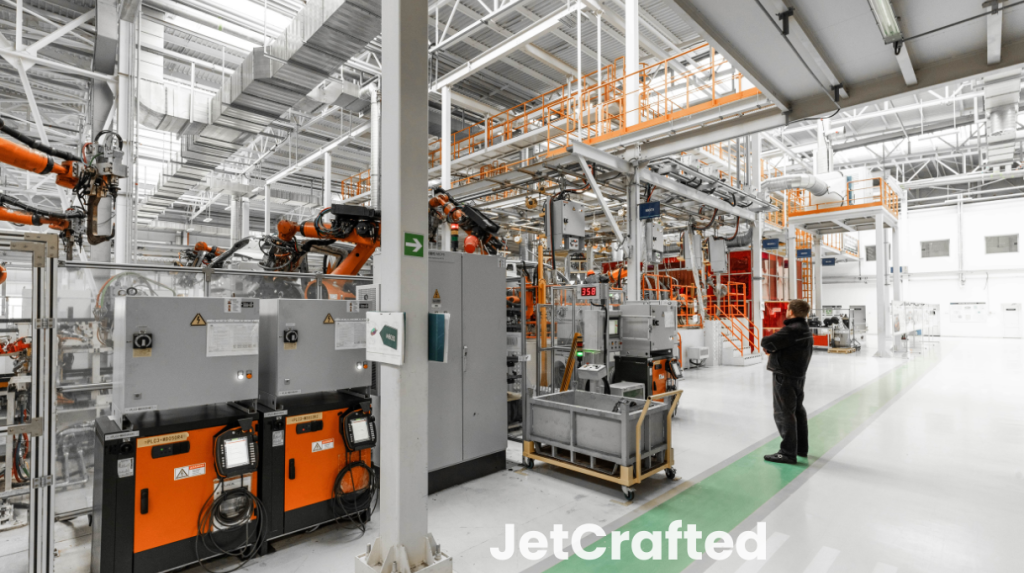
For example, JetCrafted produces large volumes of parts, which is why they need the benefits of CNC manufacturing, such as repeatability and tight tolerances. In contrast, additive manufacturing excels at creating geometries with less waste and a shorter setup time, which is good for prototyping and low-volume production.
However, CNC machining typically provides superior surface finishes and mechanical properties, making it the preferred method for industrial-grade parts and components.
Ultimately, the choice between CNC vs additive manufacturing depends on the project’s specific requirements, but the advantages of CNC machining are clear for high-precision, high-volume, and functionally demanding applications.
Difference Between AM and CNC Machining: Final Thoughts
The difference between additive manufacturing and CNC machining comes down to their core approaches: additive manufacturing builds parts layer by layer, offering design freedom and efficient prototyping, while CNC machining subtracts material to achieve high precision, repeatability, and smooth finishes in production.
Whether striving for intricate custom designs with additive manufacturing or scaling up precision components through CNC machining, the future of manufacturing will continue to be defined by the innovative use of these transformative technologies.
FAQs
1. Can Additive Manufacturing and CNC Machining be used together?
Yes, additive manufacturing and CNC machining can complement each other. Complex components can be 3D printed for intricate internal geometries and then CNC machined for precision surfaces and tight tolerances, combining the strengths of both methods for advanced manufacturing solutions.
2. Which manufacturing process is faster?
CNC machining is typically a faster process, especially in terms of high-volume production. It’s highly automated so it can quickly produce parts with precision. On the other hand, AM builds items by adding one layer at a time, which can mean a more time-consuming production, especially for items that are bigger or have a higher level of intricacy.
3. How do costs compare between Additive Manufacturing and CNC Machining for large-volume production runs?
For large-volume production, CNC machining often has lower costs per part due to its speed and efficiency in material removal. Additive manufacturing can be more expensive for mass production due to slower speeds and potentially higher material costs, making it better suited for prototyping or specialized low-volume items.