

The classic “3D printing vs. CNC machining” debate is a hot topic among industry professionals and amateur machinists alike. It always finds a way to come up when folks are discussing the best way to bring their creations to life.
In this article, we’ll go over the most noteworthy difference between CNC and 3D printing. We’ll also take a look at other factors such as material properties, production speed, cost-effectiveness, and the potential for customization, to help you pick the perfect tool for your project.
So, if you want to learn more about some more nuanced aspects of alternative manufacturing processes, let’s get straight into it.
Difference Between CNC and 3D Printing
CNC machining involves multiple processes using computer software to direct the movement of factory tools and machinery. This method relies on G-code, a programming language that controls the movements of CNC machines and their tools.
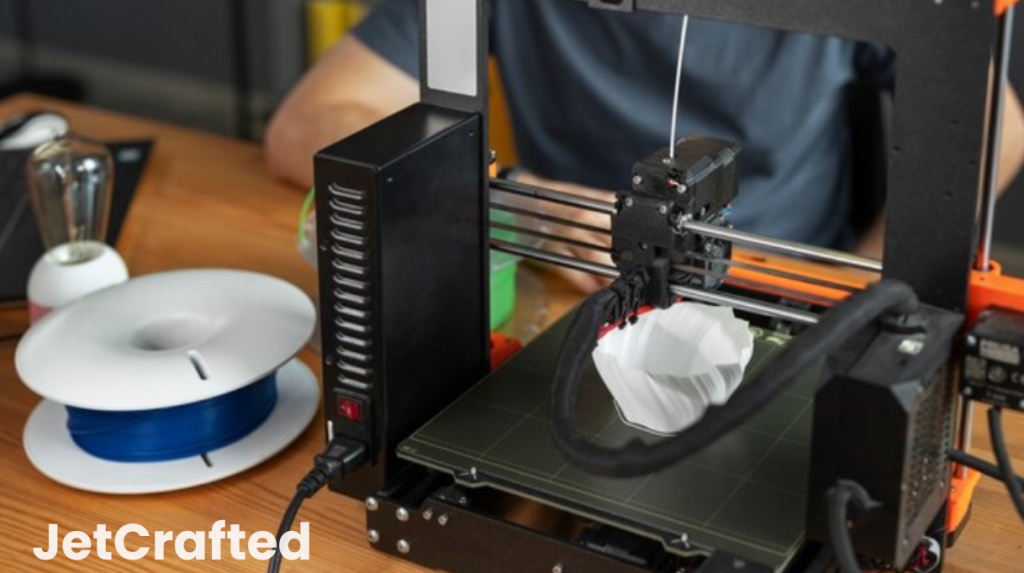
On the other hand, 3D printing is a relatively newer technique that lets you create objects layer by layer from a digital model while using a variety of materials, from plastics to metals. This simplifies the creation of complex geometries that were previously hard or impossible to produce using traditional manufacturing techniques.
Operational Methodology
The main difference between CNC machines and 3D printers lies in how they operate. CNC machining is a process where material is taken away from a solid piece to shape the final product. It uses a toolpath strategy where cutting tools, such as end mills or drills, are guided along axes for removing material.
On the other hand, 3D printing builds objects by adding material layer by layer. This additive manufacturing approach allows users to create parts with complex internal structures and intricate details without the need for multiple setups or tool changes.
Machine Components and Setup
When we take a closer look at the components and setup of these machines, we can see that a CNC machine typically has:
- Machine Frame: Provides stability and rigidity during machining operations
- Spindle: Houses the different cutting tools and rotates them at high speeds.
- Axes: Linear motion systems that control the movement of the cutting tool and workpiece.
- Tool Changer: Changes cutting tools automatically during machining operations.
- Control Unit: Interprets CNC program instructions and controls the movement of axes, spindle, and other components.
- Drive System: Turns electrical signals from the control unit into mechanical motion for the axes and spindle.
- Feedback System: Monitors the actual position of the axes and spindle and provides feedback to the control unit.
- Cooling System: Dissipates heat generated during machining operations.
- Safety features: Include emergency stops, guards, and interlocks to protect operators from harm.
On the other side of the spectrum, a 3D printer has a slightly less complex build, which includes:
- Build Platform: The surface where the 3D object is built layer-by-layer. In some cases, it can be heated to improve adhesion.
- Extruder: Feeds the printing material (filament, resin, powder) to the print head.
- Print Head: Houses the nozzle or other depositing mechanism and is responsible for accurately positioning and placing the printing material.
- Motion System: Controls the movement of the print head and/or build platform.
- Control Unit: Interprets the 3D model data and generates instructions for the motion system and extruder.
- Frame and Enclosure: Provide structural support and enclose the printing area.
3D Printing vs CNC Machining: Materials
In terms of material choices, CNC machining offers a broad selection, from metals to composites, suitable for high-precision, high-strength parts. In contrast, 3D printing provides a narrower selection of materials but allows for more intricate designs and quick builds.
Engineers and designers must know which material is suitable for each of the CNC and 3D printer manufacturing processes and how the materials will react during production. Whether opting for CNC machined or 3D printed parts, the goal remains the same – to achieve the desired look and durability in the final product.
Material Selection in CNC Machining
The workpiece, or the raw block which the final product is made from, dictates the machining approach, tooling, and, ultimately, the integrity of the CNC machined component. CNC machines can work with a wide range of materials, efficiently shaping metals, plastics, and composites to desired configurations.
Metals, ranging from aluminum to titanium, are mostly used because of their strength and durability, making them ideal for structural components. Plastics, on the other hand, are cost-effective and flexible, while composites have a unique blend of properties, such as high strength-to-weight ratios.
Material Range in 3D Printing
3D printing uses different kinds of material – filaments, resins, and metal powders. This technology layers materials to create 3D-printed parts with complex geometries. Filaments, such as ABS and PLA, are popular in Fused Deposition Modeling (FDM), while resins are used in Stereolithography (SLA), both offering a spectrum of properties tailored to diverse applications.
Metal 3D printing, which uses metal powders, is a game-changer, producing parts with a near-net shape that require minimal post-processing. However, 3D printing can work with a smaller range of materials, and the physical properties of 3D printed parts, such as surface finish and internal stresses, are different from those made with CNC machining.
Accuracy, Size Limitations And Design Complexity
When comparing 3D printing vs CNC machining, we must consider key factors such as accuracy, size limitations, and geometric complexity. Computer numerical control (CNC) machining is mainly used for its precision and capability to achieve tight tolerances.
It’s this high level of precision that sets it apart from other techniques, as even the slightest deviation can result in parts that don’t meet the required specifications.
3D printing offers a different kind of precision. While it can easily produce complex geometries, its accuracy is generally considered lower than that of CNC machining. The difference between additive manufacturing and CNC machining is evident in the layer-by-layer construction of 3D printing, which may lead to a less smooth surface finish compared to CNC machining.
Size limitations are another aspect where CNC machining and 3D printing diverge. The work envelope in CNC machining is defined by the machine’s axes and dictates the maximum size of a part that can be produced. On the other hand, 3D printers have a print volume that determines the largest object they can create.
Scaling and batch production are considerations that manufacturers must balance with lead time and turnaround time. 3D printing can be more time-consuming for larger volumes, whereas CNC machining can often produce multiple parts simultaneously, potentially reducing lead times.
Is 3D Printing Cheaper Than CNC Machining?
When comparing the cost efficiency of 3D printing and CNC machining, several factors come into play. The choice between these two manufacturing processes can significantly impact both the production speed and your bottom line. The debate of 3D printing vs CNC cost isn’t just a matter of raw numbers.
| Factor | CNC Machining | 3D Printing |
| Material Cost | Moderate | Varies depending on material type and complexity |
| Machine Cost | High | Variable, generally lower than CNC |
| Setup Cost | Moderate | Low, often included in per-part cost |
| Labor Cost | Moderate | Low, often minimal after setup |
| Tooling Cost | High, especially for complex parts | Low, often integrated into the print head |
| Waste | Moderate, scrap material can be reused sometimes | Minimal, unused material can be reused |
| Best Suited Applications | High-volume production, precision parts, diverse materials | Prototyping, low-volume production, custom parts, complex geometries |
The Advantages of 3D Printing Over CNC
While many manufacturing giants prefer the many benefits of CNC machining, 3D printing has its place in the industry as well. One significant advantage of 3D printing is that it can make prototypes very quickly. It dramatically shortens the lead time from the design to the physical part, leaving time for adjustment and improvement to the model.
Unlike CNC machining, which may require more preparation and setup time for each new design, 3D printers can begin producing a new part almost immediately after the design is finalized.
Sustainability and Material Conservation
Eco-friendliness is something that is discussed more and more in manufacturing, and 3D printing has an edge in the area of sustainability. The additive process of 3D printing typically generates less waste than the subtractive process of CNC machining, as it only uses enough material to build the part. That leads to lower production costs and a smaller environmental impact, making 3D printing a more eco-friendly option for producing parts.
3DP vs CNC: How To Choose The Right Manufacturing Technology?
The easiest way to decide between 3D printing or CNC machining is to know exactly what you want to make. 3D printing excels in short-run production and functional prototypes, due to its ability to quickly materialize complex geometries without the need for custom tooling.
CNC machining, on the other hand, is the go-to for mass production and end-use parts, offering superior strength, precision, and a high-quality surface finish even in large volumes
Cost and Time Considerations
Cost-effectiveness often relies on production volume, and a break-even analysis can help determine the most economical choice. 3D printing may be more cost-effective for low volumes, but CNC machining often becomes more viable as quantities increase due to its faster per-part production time.
Additionally, turnaround time for CNC machining is influenced by factors such as toolpath complexity and fixture setup, which should be considered alongside cost.
Final Thoughts
While the history of CNC machining is long and proven, 3D printing is slowly showing the industry why it’s here to stay with its rapid prototyping and complex geometries. When deciding between these two technologies, you should assess your production needs, material considerations, and the specificities of the design in question.
Whether going with CNC machining for its effectiveness and large-scale repeatability or using 3D printing for intricate designs, the right method affects the final manufacturing result. By considering the comparative insights provided, you can easily navigate the trade-offs of 3D printing vs CNC machining to optimize production outcomes.
FAQs
1. Can 3D printing replace CNC machining in industrial applications?
CNC excels in precision and material variety for high-volume production, while 3D printing is better for complex geometries and rapid prototyping. Both have unique benefits, making them suitable for different industrial applications, so 3D printing cannot completely replace CNC machining.
2. How do the environmental impacts of 3D printing and CNC machining compare?
3D printing is generally more environmentally friendly than CNC machining, producing less waste by using material only where needed. CNC machining is subtractive, creating potential waste from excess material, although scrap can sometimes be reused. 3D printing’s additive nature conserves resources and minimizes waste.
3. What are the limitations of 3D printing in terms of material strength?
While a wide variety of 3D printing materials are available, they typically offer less strength than those used in CNC machining. Printed parts may have anisotropic properties, meaning strength varies with orientation. Internal stresses and surface finish can also affect the part’s integrity, limiting its use in high-stress applications.